Mechanical Seal Types Explained: A 2026 Buyer’s Guide
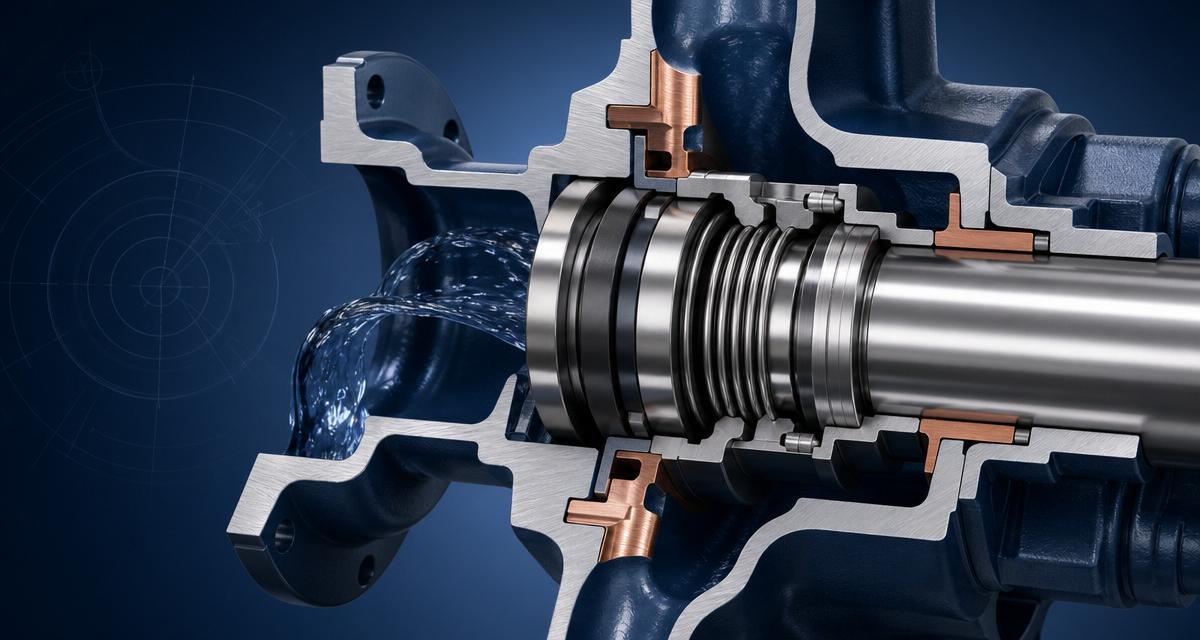
Mechanical seals are classified along three independent axes: how the spring load is applied (pusher vs non-pusher), how the seal is assembled (component vs cartridge), and how many sealing units are stacked (single vs double vs tandem). Understanding these three axes makes it easy to pick the right seal for any pump, mixer or compressor.
1. Pusher vs non-pusher seals
Pusher seals use one or more springs plus a dynamic O-ring or wedge that slides along the shaft as the faces wear. They are the most common design — inexpensive, easy to source and effective on clean fluids.
- Spring pusher seals — one large single coil or multiple small coils.
- Wedge and O-ring drive types — common in older pump platforms.
Non-pusher seals replace the sliding O-ring with a flexible bellows. Because nothing slides on the shaft, they handle fouling, hang-up and dry-running much better.
- Elastomer Bellow Seals — rubber or PTFE bellows for water, wastewater and light chemicals.
- Metal bellows seals — welded Inconel or AM350 bellows for high temperature or aggressive fluids.
2. Component vs cartridge seals
- Component seals ship as loose parts (rotary, stationary, gland, springs, O-rings). They are cheaper per unit but require accurate setting during installation. Ideal for OEM assembly lines.
- Cartridge seals are pre-assembled on a sleeve with the gland and setting clips. Bolt it on, remove the clips and run. Fewer installation errors, faster mean-time-to-repair, and much better safety on double arrangements.
If your maintenance crew installs seals in the field, choose cartridge. See cartridge vs component seals for a detailed comparison.
3. Single, double and tandem arrangements
- Single — one set of faces. Standard for benign fluids where minor emissions are acceptable.
- Double (back-to-back or face-to-face) — two sets of faces separated by a pressurised barrier fluid. Used for hazardous, toxic or valuable products where zero emissions are required. Requires a seal support system (API Plan 53/54).
- Tandem — two sets of faces with an unpressurised buffer fluid between them (API Plan 52). The inner seal takes the process pressure; the outer seal contains any leakage.
4. Specialty seals by application
Some services need purpose-built designs:
- Dry gas seals — non-contacting gas-film seals for centrifugal and axial compressors (API 692).
- Slurry and FGD seals — reinforced springs, tungsten carbide faces, open throat.
- Paper & pulp seals — clog-resistant designs for high-consistency stock.
- High-speed seals — rated up to 30 m/s for Roots blowers and gearboxes.
- Sand mill seals — TC/TC faces for bead and grinding mill duties.
- Mixer and agitator seals — dual cartridge, dry-running gas-lubricated options for reactors.
Quick selection table
| Service | Recommended type |
|---|---|
| Clean water, general-purpose pump | Single pusher, component or cartridge |
| Wastewater / HVAC circulator | Elastomer Bellow Seals |
| Hot hydrocarbon (>200 °C) | Metal bellows cartridge |
| Hazardous / toxic process | Double cartridge + API Plan 53 |
| Centrifugal compressor | Tandem dry gas seal |
| Abrasive slurry | Slurry seal with Plan 32 flush |
How to choose
Selecting a seal requires more than matching a part number. Evaluate operating pressure, temperature, fluid chemistry, shaft speed, seal chamber dimensions and the presence of solids or abrasive media. Astra Mechanical Seals supplies replacement seals across all major pump and mixer brands, with material options tailored to each application.
Ready to specify? Browse the full catalog or request a quote with your equipment details.
Related Articles
Elastomer Bellow Seals: When to Use Them (and When Not To)
Elastomer bellows seals replace springs and dynamic O-rings with a flexible rubber bellows. Learn when they win, their limits, and OEM cross-references.
Buyer’s GuideHow to Select a Mechanical Seal for a Slurry Pump (2026 Guide)
Step-by-step selection guide for slurry pump mechanical seals: face materials, flush plans, single vs double, and OEM cross-references for mining, FGD and dredging service.
Buyer’s GuideCartridge vs Component Mechanical Seals: Which Should You Use?
Cartridge seals ship pre-assembled; component seals ship as loose parts. Compare cost, installation time, safety and repair speed to pick the right one.
Explore Related Seal Categories
Browse the seal families most closely tied to this article:
Need a replacement mechanical seal?
Browse our catalog of high-performance replacement seals, or send us your equipment details and our engineers will recommend the right seal for your application.