Elastomer Bellow Seals: When to Use Them (and When Not To)
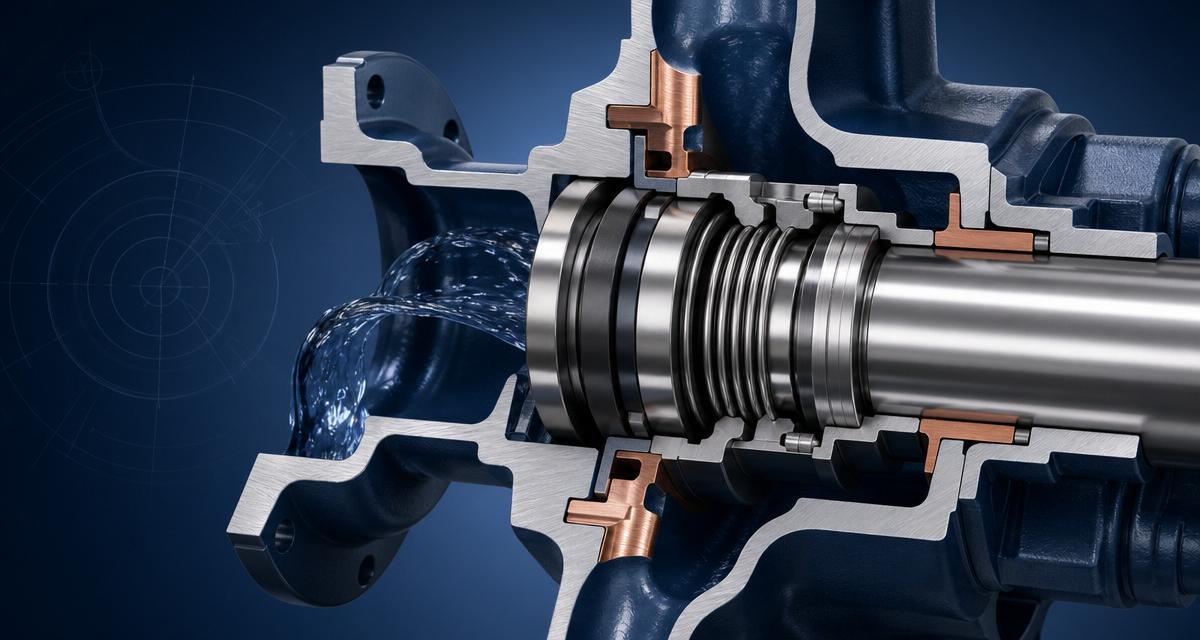
An Elastomer Bellow Seal is a non-pusher mechanical seal design that uses a moulded rubber bellows instead of a spring plus dynamic O-ring. The bellows both loads the faces and absorbs shaft movement, giving the seal excellent tolerance for fouling, hang-up and small amounts of dry running. This makes it a workhorse in HVAC, wastewater, sanitary and light chemical services.
How the design works
The elastomer bellows is bonded or clamped to the shaft at one end and to the rotating face at the other. As the pump runs, three things happen inside the bellows:
- It supplies the axial closing load that keeps the faces in contact.
- It absorbs radial run-out and lateral shaft movement without dragging on the shaft.
- It seals between the rotating face and the shaft — no O-ring sliding, no fretting, no hang-up.
The net result is a much more forgiving seal on services that would clog or hang a pusher design.
Where elastomer bellows win
- HVAC circulator pumps — decades of proven service in building water loops.
- Wastewater and effluent pumps — resists stringy debris, low-solids slurries and grease.
- Clean-water booster pumps — low cost, easy installation, long life.
- Submersible pumps — compact, tolerant of shaft misalignment.
- Low-pressure chemical pumps — with a compatible elastomer (EPDM, Viton, NBR).
Common OEM cross-references include John Crane Type 21 / Type 6A, Sepco 500 series and Chesterton 155.
Limits to be aware of
Elastomer bellows are the right choice for a wide range of duties but they are not universal:
- Pressure limit typically 10 bar (145 psi). Above this, pick a cartridge pusher or metal bellow.
- Temperature limit depends on elastomer: NBR to 100 °C, EPDM to 120 °C, Viton to 200 °C.
- Chemical compatibility is dictated by the elastomer chosen — always cross-check with a compatibility table.
- Not suitable for highly aggressive solvents that swell or attack the bellows. For those, choose a PTFE bellows or metal bellows design.
Elastomer material selection
| Elastomer | Best for | Avoid |
|---|---|---|
| NBR (nitrile) | Water, oils, hydraulic fluid | Ozone, aromatics, ketones |
| EPDM | Hot water, steam, alcohols | Petroleum oils |
| Viton (FKM) | Fuels, mild acids, chlorinated | Ketones, esters, amines |
| Aflas | Aggressive chemicals, high temp | Aromatics |
When to choose something else
- Solvent or aggressive-chemical service — use metal bellows.
- Above 10 bar — use a cartridge pusher seal.
- Zero-emissions or toxic services — use a double cartridge with API Plan 53.
- Compressors — use a dry gas seal per API 692.
For a broader map of every seal family, see our mechanical seal types guide.
Ordering an elastomer bellow seal
Send us the pump make and model, the shaft diameter, the operating temperature, and the fluid. We stock the John Crane Type 21 / Type 6A equivalents in the common shaft sizes and can ship replacements within a week. Request a quote.
Related Articles
Mechanical Seal Types Explained: A 2026 Buyer’s Guide
Every major mechanical seal type explained — pusher, non-pusher, cartridge, component, single, double, dry gas and more. Includes selection guide and cross-references.
Buyer’s GuideCartridge vs Component Mechanical Seals: Which Should You Use?
Cartridge seals ship pre-assembled; component seals ship as loose parts. Compare cost, installation time, safety and repair speed to pick the right one.
Buyer’s GuideHow to Select a Mechanical Seal for a Slurry Pump (2026 Guide)
Step-by-step selection guide for slurry pump mechanical seals: face materials, flush plans, single vs double, and OEM cross-references for mining, FGD and dredging service.
Explore Related Seal Categories
Browse the seal families most closely tied to this article:
Need a replacement mechanical seal?
Browse our catalog of high-performance replacement seals, or send us your equipment details and our engineers will recommend the right seal for your application.