How Does a Mechanical Seal Work? Faces, Films & Forces
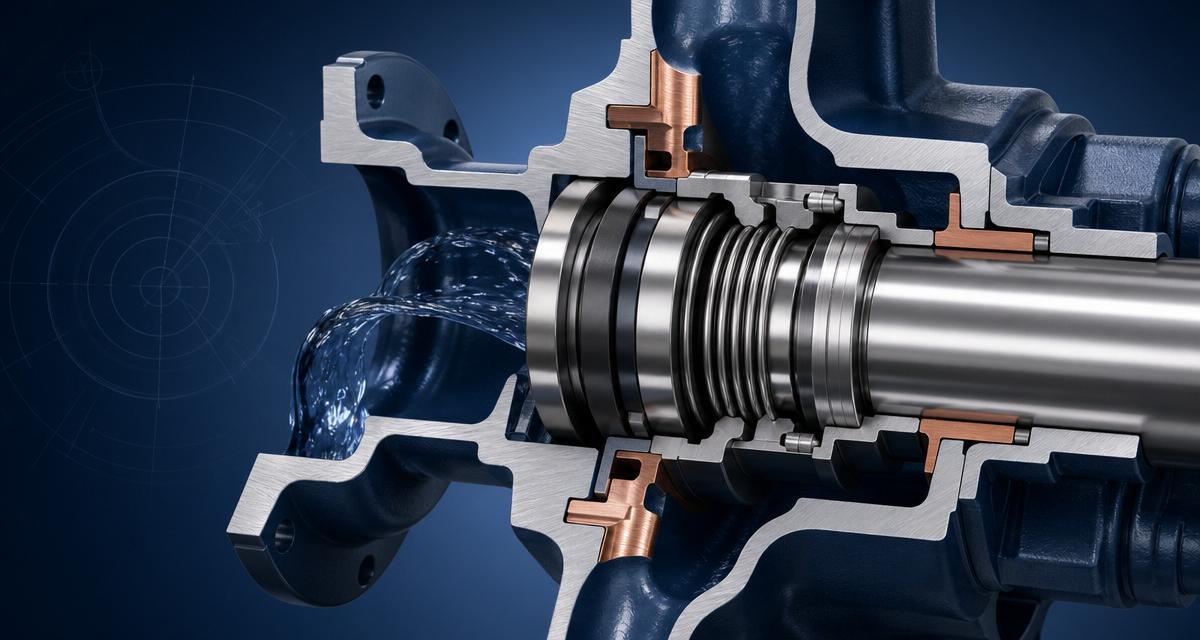
A mechanical seal works by pressing two ultra-flat faces together around a rotating shaft. One face turns with the shaft, the other stays fixed in the housing, and a microscopic film of liquid or gas between them does the actual sealing. This article walks through exactly how that happens, why the film is critical, and what fails when a seal starts leaking.
The four sealing points
Every mechanical seal has four leakage paths that must be closed simultaneously:
- Between the rotating face and stationary face — sealed by the fluid film and the flatness of the faces themselves.
- Between the rotating face and the shaft/sleeve — sealed by a dynamic O-ring or bellows.
- Between the stationary face and the housing — sealed by a static gasket or O-ring.
- Between the gland plate and the equipment — sealed by a gasket bolted into the stuffing box.
If any of these four points opens up, the seal leaks. Good design keeps all four sealed under every operating condition — startup, shutdown, thermal shock and pressure spikes.
Step-by-step: what happens when the pump starts
- Static state. The spring or bellows preload holds the two faces together. There is almost no gap.
- Shaft rotation begins. Friction generates heat at the interface; a thin layer of process fluid is drawn between the faces by hydrodynamic action.
- Steady state. The film thickness settles at roughly 0.25–2.5 micrometres — thick enough to lubricate the faces, thin enough that very little fluid escapes past them.
- Wear balancing. As the faces wear microscopically, the spring pushes the rotating face forward to maintain contact. The dynamic O-ring pushes along the shaft — the origin of the term "pusher seal".
The role of the fluid film
The fluid film is what makes a mechanical seal work. Too thick and process fluid leaks past. Too thin and the faces contact directly, generating heat and destroying them in minutes.
Film behaviour depends on:
- Face flatness — usually lapped to within 3 helium light bands (≈0.9 µm).
- Face material pair — Silicon Carbide vs Carbon is the most common combination for water and light chemicals.
- Spring load — enough to keep contact under vacuum, low enough to avoid crushing the film.
- Fluid properties — viscosity, vapour pressure and cleanliness all affect film stability.
When the film fails
Most seal failures are film failures. A dry-run event, flashing across the face, or abrasive particles wedging between the faces will all break down the lubricating layer. The result is thermal cracking, heat checking, or complete face destruction — usually within seconds.
Choose a seal that matches your service
Understanding the sealing mechanism makes selection straightforward. If your process runs hot, choose a metal bellows seal. If it runs abrasive, choose tungsten carbide faces with the right flush plan. If you cannot afford any leakage, choose a dry gas seal.
Not sure which arrangement fits your equipment? Send us your specifications and our engineers will recommend a seal matched to your operating conditions.
Related Articles
What is a Mechanical Seal? A Complete Guide
Learn what a mechanical seal is, how it works, the main types, and why it matters for pumps, mixers, compressors and other rotating equipment.
Engineering GuideAPI Plan 32 vs Plan 53: Which Mechanical Seal Flush Plan to Use
Side-by-side comparison of API Plan 32 (external flush) and Plan 53 (pressurized barrier) for mechanical seals — costs, applications, piping, and when to choose each.
Engineering GuideDry Gas Seal vs Wet Seal (API 692): Which Compressor Seal to Use
Dry gas seals and wet oil seals both seal centrifugal compressors. Compare leakage, safety, cost and the API 692 standard to pick the right compressor seal.
Explore Related Seal Categories
Browse the seal families most closely tied to this article:
Need a replacement mechanical seal?
Browse our catalog of high-performance replacement seals, or send us your equipment details and our engineers will recommend the right seal for your application.